A mudrā Sanskrit: मुद्रा, lit. "seal", is a symbolic or ritual gesture in Hinduism and Buddhism. A mudrā is a spiritual and energetic seal in the spiritual practice of East Asian religions. Some mudrās involve the entire body, but most are shown with hands and fingers. Some important mudras are: Dhyani Mudra Gesture of Meditation Vitarka Mudra Gesture of Teaching Dharmachakra Mudra Turning the Wheel of Dhamma Bhumisparsha Mudra Gesture of Touching Earth - Enlightenment Abhaya Mudra Gesture of Fearlessness/Protection Varada Mudra Gesture of Granting Wishes Uttarabodhi Mudra Gesture of Supreme Enlightenment Anjali Mudra Gesture of Greeting and Veneration Vajrapradama Mudra Gesture of Unshakable Confidence Maha Mudra Gesture of Supreme Wisdom Dhyani Mudra In a special form of this mudra, middle, ring, and little fingers of both hand s lie on top of one another ande the thumbs and index fingers of each hand, touching each other, form a circle, which symbolizes the world of appearance and true nature of reality. Vitarka Mudra Dharmachakra Mudra The left palm is turned in (toward the body), right out, and circles formed by thumbs and index fingers of each hand touch. Bhumisparsha Mudra Left hand rests palm up in lap; right hand, hanging over knee, palm in, points down to earth. Sometimes left hand holds a begging bowl. This is the gesture Buddha summoned Earth as witness to realization of buddhahood. It is a gesture of unshakability; Akshobhya (the Unshakable) is depicted with this mudra. Abhaya Mudra Varada Mudra Right hand, palm facing out, is down. When Shakyamuni is depicted with this mudra, it symbolizes summoning Heaven as witness to buddhahood. In a variant, thumb and index finger of down extended hand touch. Frequently abhaya and varada mudras are combined: right hand makes gesture of fearlessness, left of wish granting. Uttarabodhi Mudra Both hands are held at level of chest, two raised index fingers touch, remaining fingers are crossed and folded down;thumbs touch at tips or crossed and folded. Mudra of Supreme Wisdom Right index finger is grasped by five fingers of left hand. This mudra represents the realization of unity in the manifold as embodied in Buddha. Anjali Mudra Palms held together at level of chest. This is customary gesture of greeting in many Asian countries. Used as a mudra, it expresses "suchness" (tahata). Vajrapradama Mudra Fingertips of hands are crossed. This is gesture of unshakable confidence.
In this mudra, back of right hand rests in palm of other with tips of thumbs lightly touching. The hands rest in lap. The right hand, resting on top, symbolizes state of enlightenment; the other below, the world of appearance. This gesture expresses overcoming the world of appearance through enlightenment, as well as the enlightened mind where samsara and nirvana are one. Right hand up, left down; both palms turned out. The thumb and index finger of each hand form a circle. Right hand is shoulder level, left hand is hip level. A variant is left hand rests palm up in lap, and right hand raised to shoulder level with thumb and index finger forming circle. Another form is with index finger and little fingers of both hands fully extended, middle and ring fingers curved in. The left hand points up, right points down.


Right hand is raised to shoulder height with fingers extended and palm turned out. This is gesture of Buddha Shakyamuni immediately after attaining enlightenment.


 The Abhaya mudrā ("mudrā of no-fear")
In Laos, the mudrā is shown with both hands making a double Abhaya mudrā that is translated as "No War". The abhaya mudra on a (standing) walking Buddha is called 'the Buddha placing his footprint' and is unique to this region.
In a region that has suffered colonialism, civil war and the largest bombing mission throughout the American-Vietnam war, this is a particularly poignant symbol.
The US dropped two million tons and 580,000 bombing missions - the equivalent of a planeload of bombs every 8 minutes, 24-hours a day, for 9 years in a secret bombing campaign from 1964-1973.

The bombing was an effort to destroy North Vietnamese supply lines and fend off the North Vietnamese Army. The Ravens, U.S. pilots in Laos, flew 1.5 times the number of air sorties flown in all of Vietnam.
Each cluster bomb scattered several hundred tennis-ball-sized bomblets (known as bombies in Laos) over 5000-sq-meter areas. About 260 million cluster bomblets fell over Laos with close to 53 million bomblets dropped within one kilometer of villages.
Up to 30% of the bomblets did not detonate on impact, leaving an estimated 86 million unexploded cluster bomblets buried in fields, roads, forests, rivers and villages. Laos continues to have the largest unexploded landmines and bombs of any nation.
http://www.legaciesofwar.org/traveling-exhibit/history/history-bombing-laos
Perhaps we can remember this reminder of how important it is to promote Peace on the planet.
...No War, Protection, Fearlessness, Benevolence to all beings...
Upajjhatthana Sutta - Five Daily Remberances
Kammassakomhi kammadāyādo kammayoni kammabandhū kammapaṭisaraṇo yaṃ kammaṃ karissāmi kalyāṇaṃ vā pāpakaṃ vā tassa dāyādo bhavissāmī...
I am the owner of my actions, heir to my actions, born of my actions, related to my actions, abide supported by my actions. For whatever actions I do, for good or for ill, of these I shall be the heir.

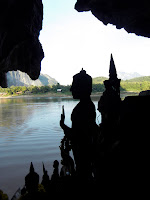
OK folks...I have seen a Lot of weird things in my travels, but this one is pretty WILD! A trip to the sacred Pak Ou caves up the river where locals have brought buddhas (4000+) for 100s of years is an awesome sight. Full of prayer and well wishes, these caves guard over the majestic Mekong and the Naga (mystical water snakes) protects the villagers. In fact the villages near these caves believe in the magical power of the Naga so much that thy even make a whiskey that includes the venom of local snakes...this whiskey is used for medicinal benefit and is supposed to have the power to heal many illnesses. This snake medicine is primarily used for men and the illnesses served include arthritis, skin rashes and problems, and will help keep you virile into old age! I am not sure about you, but I will stick to my organic Dr Hauschka creams! Considered for a nanosecond or less to get one, but then thought about it breaking in my luggage.... Of course, they did have a <3oz> Love and laughter from Laos!


